Faster Asteroid Models Reveal New Deflection Risks
Faster Asteroid Models Reveal New Deflection Risks
An improved asteroid-deflection model gives planetary-defense researchers a faster way to examine dangerous impact scenarios. The development does not indicate that a known asteroid is currently on a collision course with Earth. Instead, it shows how more efficient simulations can improve preparedness while exposing risks that simpler calculations may miss.
The research, covered by The Register, concerns modeling capability rather than a confirmed asteroid emergency Source 1.
What an Asteroid-Deflection Model Does
An asteroid-deflection model is a computer simulation that estimates how an object moves through space and how an intervention could change its future path.
The model uses observations of an asteroid’s position and velocity, then calculates the effects of gravity from the Sun, Earth, and other bodies. Depending on its design, it may also include less obvious forces, such as heat-driven changes in the asteroid’s motion.
Scientists rarely know an asteroid’s orbit with perfect precision. Short observation periods and measurement errors create a range of possible trajectories, known as orbital uncertainty. Most paths may result in a harmless miss, while a smaller number could bring the object close to Earth or intersect its orbit years or decades later.
Small differences in velocity can produce large positional changes over time. This is why impact risk cannot always be represented by a single fixed trajectory.
Simulating a Deflection Attempt
A deflection model can assess variables such as:
- Asteroid mass, size, density, shape, and internal structure.
- Intervention timing and distance from Earth.
- The magnitude and direction of the applied force.
- Remaining warning time.
- Uncertainty in the asteroid’s original trajectory.
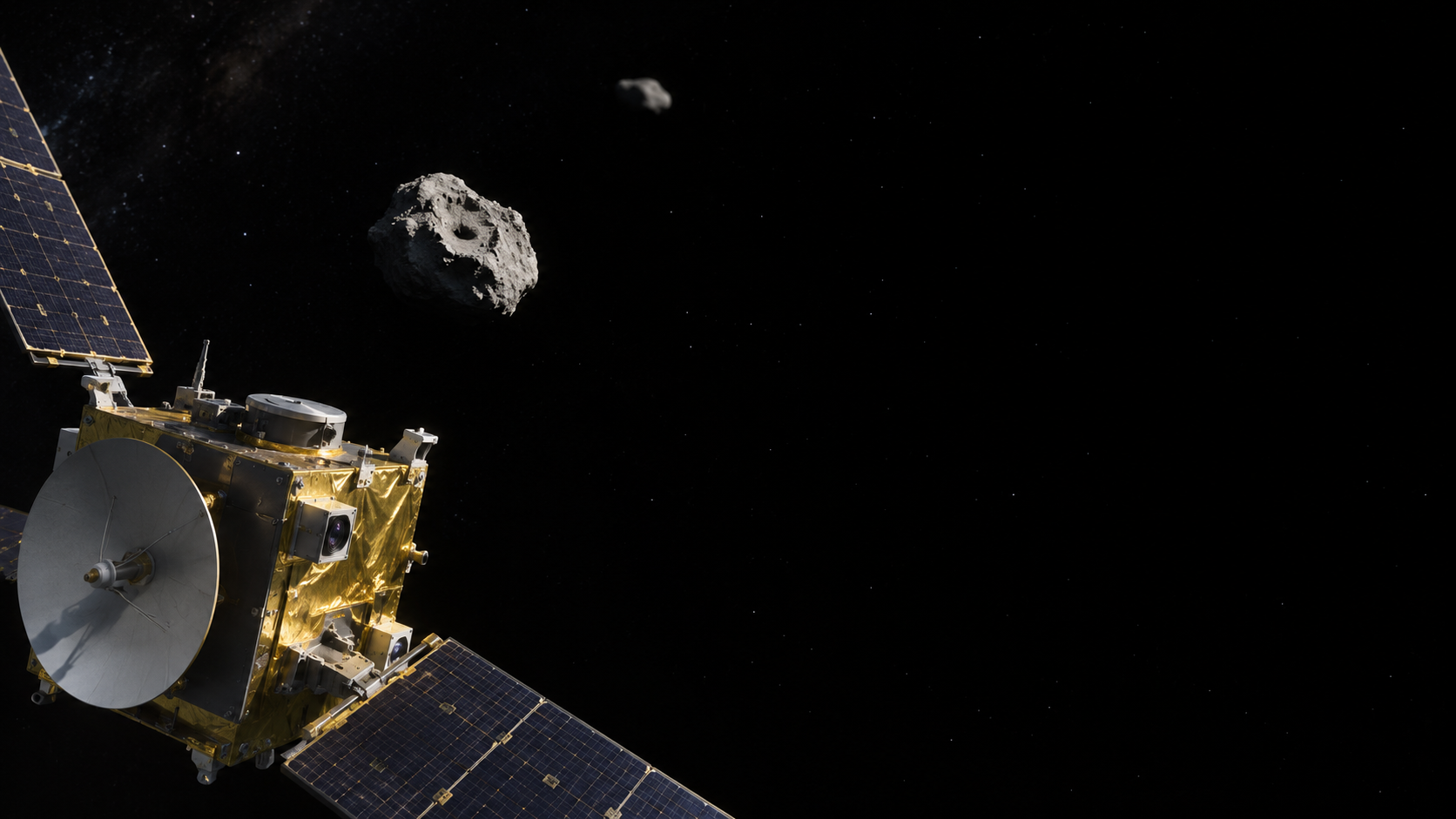
Deflection usually means changing an asteroid’s path enough to prevent an impact, not destroying the object. A spacecraft impact is one possible method. Other concepts include gravitational interaction with a spacecraft and, under extreme conditions, a nuclear explosive device.
Disruption is a separate challenge. Breaking an asteroid apart might prevent one large impact but create multiple fragments with different trajectories. Those fragments could be difficult to track and could produce several impact risks. A complete model must examine both the original object and the material left behind.
Why Faster Modeling Matters
More Simulations in Less Time
A faster model can run more cases using the same computing resources. Researchers can vary assumptions and examine combinations involving:
- Asteroid mass, shape, density, and spin rate.
- Impact angle and deflection force.
- Intervention distance and warning period.
- Tracking uncertainty.
- Spacecraft failure.
- Fragmentation behavior.
A limited simulation may test only a few representative cases. A faster system can explore a broader range, making it easier to identify sensitive variables and outcomes that might otherwise remain hidden. Researchers can also rerun the model quickly when new telescope measurements or revised physical estimates become available.
Better Testing Under Uncertainty
Planetary-defense teams may have incomplete information about a newly discovered asteroid. It may be faint, rapidly rotating, or difficult to observe from Earth. Its orbit and physical structure may also be uncertain.
Faster simulations help separate several categories of outcome:
- Best-case outcomes: The intervention produces the expected trajectory change, and the object remains safely away from Earth.
- Likely outcomes: The asteroid avoids impact but retains some tracking or monitoring uncertainty.
- Low-probability, high-consequence outcomes: A rare trajectory or fragmentation pattern creates a serious secondary threat.
A model does not provide one definitive answer that removes uncertainty. It maps possible outcomes and shows how strongly each result depends on the assumptions.
Supporting Time-Sensitive Decisions
Speed is especially valuable when an asteroid is discovered late or when new observations substantially change its calculated path. A faster model could help teams compare options during early detection, orbit updates, mission design, deflection planning, and post-intervention tracking.
Faster calculations cannot replace telescopes, spacecraft, launch systems, or international cooperation. They can make those resources more effective by clarifying which actions are most useful under current conditions.
How Better Models Reveal Additional Risks
Simplified models often ask whether an asteroid hits Earth or misses. An improved model can examine what happens between those outcomes. It may show that an intervention:
- Reduces the immediate impact probability without eliminating it.
- Moves the object into a different possible impact corridor.
- Creates a wider range of post-deflection trajectories.
- Produces fragments requiring separate tracking.
- Leaves a future encounter possible after the original threat has passed.
These results do not predict that a particular disaster will occur. They show that the intervention itself must be assessed as part of the risk.
Deflection Is Not a Simple Hit-or-Miss Problem
Asteroid-impact risk exists on a spectrum. A scenario may involve a high-confidence impact, a reduced but nonzero probability, a close approach, a delayed impact possibility, an uncertain post-deflection orbit, or multiple fragments with separate trajectories.
Calling an asteroid “saved” or “destroyed” may be inaccurate if an intervention merely lowers the probability of one outcome while creating uncertainty about another. A more useful measure of success is risk reduction. Moving a large asteroid away from a populated region, reducing its impact energy, or increasing warning time could all improve the result.
New Trajectory Problems
Changing an asteroid’s orbit changes its future relationship with Earth and other celestial bodies. The new trajectory may prevent an immediate impact but create a later close approach. Monitoring would therefore need to continue after a deflection mission.
Scientists would have to determine the object’s new orbit, compare it with updated observations, and assess whether the impact probability had changed. A modeled risk is not the same as a likely event; a later impact may be possible only under a narrow set of conditions.
Worst-Case Scenarios as Planning Tools
Planetary defense examines extreme scenarios because rare events can have severe consequences. Stress-testing a model can reveal:
- When an intervention becomes less effective.
- Which observations would reduce uncertainty most.
- Which spacecraft designs carry unacceptable secondary risks.
- How much warning time a mission requires.
- What monitoring should continue after deflection.
The key distinction is between possibility, probability, and prediction. A possible outcome is not necessarily probable, and a probable outcome is not a prediction that the event will occur.
Technical Challenges in Asteroid Deflection
Limited Knowledge of Physical Properties
Tracking an asteroid’s orbit does not necessarily reveal its internal structure. Scientists may have limited information about its density, porosity, spin state, surface composition, structural strength, and internal layering.
Two asteroids of similar size could respond differently to the same spacecraft impact. One might behave like a solid body, while another could absorb energy or disperse into fragments. A faster model can test more physical assumptions, but observations are still needed to identify the correct ones.
Observation Gaps and Uncertain Orbits
Reliable orbit calculations require repeated measurements over time. Short observation windows create greater uncertainty, especially when an asteroid is faint or difficult to observe. Incomplete measurements, long prediction horizons, limited viewing opportunities, small non-gravitational forces, and uncertainty about rotation and shape can all affect the result.
More computing power can process uncertainty more efficiently, but it cannot replace missing data. Better models must be matched with better observation networks.
Timing and Distance
Early intervention generally provides more time to alter an asteroid’s future position. A small velocity change applied far from Earth can accumulate over years, while a late intervention may require greater force.
The best strategy still depends on the asteroid’s orbit, size, composition, warning time, and available mission technology. Modeling helps researchers compare these factors rather than rely on a single rule.
International Decision-Making
Planetary defense is also a coordination challenge. A technical model cannot decide who confirms a threat, authorizes a mission, provides launch capability, communicates uncertainty, or prepares communities for possible impact effects.
Faster simulations can support those decisions by producing updated risk ranges. Decision-makers need clear information about confidence, timing, possible outcomes, and consequences—not only complex orbital data.
What the Improved Model Could Change
Researchers could use faster simulations to compare mission concepts before launch. Applications may include selecting an interception date, estimating spacecraft mass, comparing impact angles, testing multiple spacecraft, evaluating alternative deflection methods, and planning follow-up observations.
A deflection mission would not end the scientific task. Teams would need to determine whether the asteroid followed the expected path and whether its physical state changed. Follow-up analysis could examine the new orbit, search for fragments, reassess impact probability, evaluate the original estimate, and determine whether another intervention was needed.
Improved models can also support clearer public communication. Agencies should distinguish between detection and confirmed danger, possibility and probability, hypothetical simulations and observed evidence, and modeled scenarios and current events.
What the Model Does Not Prove
The reported research does not identify a specific asteroid headed for Earth, provide an impact date, or confirm an imminent global catastrophe Source 1.
It also does not eliminate the need for telescopes, radar observations, follow-up tracking, space-based observatories, or spacecraft reconnaissance. Simulations depend on their inputs, and faster calculations cannot guarantee a successful deflection.
Any real intervention would depend on detection time, asteroid composition, mission reliability, deflection magnitude, navigation accuracy, and trajectory-prediction quality. The model is a decision-support tool, not a planetary shield.
Interpreting the Doomsday Angle Without Sensationalism
Asteroid impacts are low-frequency but potentially high-consequence events. The phrase “doomsday scenario” reflects the possible scale of damage, but it can obscure the practical purpose of the research.
The important question is whether the simulation improves the ability to detect, assess, and reduce a threat. Studying unlikely but severe outcomes can reveal weak points before they matter, including ineffective intervention conditions, critical observations, fragmentation risks, and post-deflection monitoring requirements.
Identifying a risk is not the same as creating one. It is part of reducing it.
Conclusion
The improved asteroid-deflection model matters because it can evaluate more possibilities in less time. That speed may help researchers compare intervention strategies, process new observations, and identify uncertainties before a real mission becomes necessary.
The same capability can reveal complicated failure modes. A deflection may reduce one danger without eliminating every future risk. Fragmentation, uncertain trajectories, delayed encounters, and incomplete physical data can make planetary defense more complex than a simple hit-or-miss calculation.
The development does not signal an imminent apocalypse. It shows why asteroid-impact preparedness requires detection systems, accurate observations, spacecraft capability, international decision-making, continued tracking, and responsible public communication. Faster modeling strengthens that system by exposing the risks hidden between success and failure.
Frequently Asked Questions
What is an asteroid-deflection model?
It is a computer simulation that estimates how an intervention could change an asteroid’s trajectory while accounting for its orbit, size, mass, timing, and observational uncertainty.
Why is a faster asteroid model important?
It allows researchers to test more scenarios, process new observations more quickly, and compare intervention strategies under different assumptions. It improves analysis but does not eliminate uncertainty in the underlying data.
Does the improved model mean an asteroid will hit Earth?
No. The improvement concerns simulation speed and capability. It does not confirm an imminent impact or identify a specific asteroid on a collision course with Earth.
Why can better modeling reveal more doomsday concerns?
Detailed simulations can expose failure modes that simpler models overlook, including uncertain post-deflection trajectories, fragmentation risks, and threats that are reduced but not completely eliminated. A possible outcome is not necessarily a probable one.
Is asteroid deflection the same as destroying an asteroid?
No. Deflection changes an asteroid’s path to avoid an impact. Disruption breaks the object into fragments, which may create additional tracking and impact risks.
What else is needed besides a faster model?
Planetary defense also requires early detection, precise orbit tracking, knowledge of physical properties, reliable spacecraft, follow-up observations, international coordination, and clear public communication.