What Earth Might Be Like Without Life
What Earth Might Be Like Without Life
Earth appears to be a rocky planet shaped by volcanoes, oceans, erosion, sunlight, and climate. Yet nearly every familiar feature also reflects the influence of life. Organisms have transformed the atmosphere, surface chemistry, carbon cycle, soils, minerals, and even the appearance of continents over geological time.
Scientists model a hypothetical lifeless Earth to explore how the planet might have evolved if life had never appeared. The goal is not to reconstruct an alternate history in exact detail. Instead, the model establishes a scientific baseline for understanding how geology, chemistry, oceans, and climate could shape an Earth-like planet without biology.
This comparison has implications beyond the Solar System. When astronomers study an exoplanet, they may detect atmospheric gases or surface conditions that appear compatible with life. However, non-biological processes can sometimes produce similar signals. A model of Earth without life helps researchers determine which planetary features are difficult to explain without biology.
The simulation can improve the search for extraterrestrial life by distinguishing biological effects from geological and chemical ones. It may help scientists identify potential biosignatures, recognize false positives, and prioritize distant worlds for further observation.
What Scientists Mean by a “Lifeless Earth”
A Planet Without Biological Activity
A lifeless-Earth simulation represents a planet where organisms never evolved. It excludes microbes, plants, animals, ecosystems, biological evolution, and biological element cycles.
This scenario differs from a planet where life once existed and later disappeared. If life vanished after billions of years, the atmosphere, oceans, minerals, and sediments would already contain a long biological history. A planet that never developed life would follow a different path from the beginning.
It would not be modern Earth with its organisms simply removed. Life has changed Earth’s atmosphere and surface so extensively that removing it from the present planet would not produce a realistic picture of an original barren world. Instead, scientists must model how Earth could have developed over long periods without biological feedback.
The simulation is a counterfactual experiment. Researchers retain physical processes that do not require organisms, then calculate how those processes could shape the atmosphere, climate, oceans, and surface.
The Physical Processes That Remain
A lifeless planet would still be active. It could experience:
- Volcanic eruptions and gas release.
- Rock weathering.
- Ocean evaporation and precipitation.
- Atmospheric circulation.
- Erosion caused by wind, water, and ice.
- Chemical reactions among rocks, oceans, and air.
- Mineral and sediment formation.
- Solar radiation and seasonal climate changes.
These processes can create complex planetary environments without biology. Volcanoes can add gases to the atmosphere, oceans can absorb and release chemicals, rocks can remove atmospheric compounds through weathering, and sunlight can drive photochemical reactions.
This complexity creates a central challenge for astrobiology: a planet does not need life to have an atmosphere, clouds, oceans, weather, or chemical disequilibrium. Scientists must determine whether a detected feature is more likely to result from biology or from a non-biological process.
How Life Has Reshaped Earth
The Atmosphere Is Not Biologically Neutral
Earth’s atmosphere reflects interactions among rocks, oceans, sunlight, and living organisms. Life consumes some gases, releases others, and changes how elements move between the atmosphere, oceans, crust, and sediments.
Biological activity can remove carbon dioxide, release oxygen, produce methane, and alter the chemistry of oceans and soils. Over long periods, these effects can change the climate and the minerals found at the surface.
No single atmospheric gas automatically proves the presence of life. Volcanic processes, photochemical reactions, and water-rock interactions can produce molecules that also occur in biological environments. Scientists therefore study gases within the broader planetary system, including the star’s radiation, the planet’s temperature, atmospheric pressure, surface composition, ocean conditions, and geological activity.
Photosynthesis and the Oxygen-Rich Atmosphere
Photosynthesis is one of the clearest examples of life transforming a planet. Photosynthetic organisms use sunlight to convert carbon dioxide and water into energy-rich compounds, releasing oxygen as part of the process.
Over time, biological oxygen production altered Earth’s atmosphere, oceans, and surface minerals. Oxygen also changed the chemical environment available to living organisms, helping create conditions in which more complex life could develop.
An oxygen-rich atmosphere can be an important biosignature candidate, but oxygen is not definitive evidence of life on an exoplanet. Certain combinations of stellar radiation, atmospheric chemistry, and water loss can generate oxygen without biological activity.
Scientists must interpret oxygen alongside other observations. They may ask whether another gas is present that could react with oxygen, whether the host star provides the necessary radiation, and whether the planet’s surface and atmosphere offer a plausible non-biological source.
Carbon Cycling and Climate Regulation
Life participates in Earth’s carbon cycle, which moves carbon through the atmosphere, oceans, soils, sediments, organisms, and rocks.
Plants and microbes absorb carbon dioxide, while respiration returns carbon to the atmosphere. Organic material can accumulate in sediments, and ocean organisms can influence the movement of carbon between seawater and the seafloor. Over long periods, these processes affect the concentration of greenhouse gases in the atmosphere.
A lifeless Earth would still have a carbon cycle, but geology and chemistry would dominate it. Volcanoes could release carbon dioxide, weathering could remove it from the atmosphere, oceans could absorb and exchange carbon, and sediments and minerals could store it.
The balance among these processes would differ without organisms. Comparing biological and non-biological carbon cycles helps scientists estimate how strongly life influences long-term climate.
Biology’s Effects on the Surface
Life changes the physical surface as well as the atmosphere. Plants contribute to soil formation, break apart rocks with their roots, influence erosion, and alter how water moves across land. Microbial communities can transform minerals and sediments, while organic deposits can preserve chemical evidence of biological activity.
A lifeless Earth would have no forests, grasslands, biological soil communities, microbial mats, or animal activity. Its surface would instead be shaped by water, wind, ice, volcanism, tectonics, and chemical weathering.
Surface appearance alone would not reliably identify life. Clouds, ice, oceans, deserts, and mineral deposits can create strong signals when viewed from space. A barren planet could still appear active and visually complex.
What the Simulation Is Designed to Reveal
Establishing a Planetary Baseline
The main purpose of a lifeless-Earth simulation is to create a baseline for planetary comparison. Scientists can ask:
- Which atmospheric features depend strongly on life?
- Which gases can emerge through geology or chemistry?
- Which combinations are difficult to produce without organisms?
- How does biological activity alter climate over long periods?
- Which potential biosignatures remain stable enough to detect?
This baseline reduces the risk of interpreting every unusual observation as evidence of life. A planet may have an interesting atmosphere that remains explainable through volcanic activity, water-rock reactions, or stellar radiation.
The model does not eliminate uncertainty. It improves comparisons among competing explanations. Source 1
Separating Biological and Non-Biological Signals
Telescopes can sometimes analyze exoplanet atmospheres by measuring how starlight passes through or reflects from them. These observations are limited, and scientists usually cannot inspect an entire planetary system directly.
Models provide the context needed to interpret those measurements. A lifeless-Earth model can reveal false positives: signals that resemble evidence of life but have non-biological explanations.
Potential false-positive sources include:
- Volcanic gas release.
- Photochemical reactions driven by starlight.
- Water reacting with minerals.
- Atmospheric escape.
- Radiation from the host star.
- Chemical changes caused by oceans or ice.
A convincing biosignature should be assessed alongside multiple atmospheric gases, the planet’s climate, the star’s radiation, possible geological sources, and surface or ocean conditions.
Modeling Long-Term Planetary Change
Time is essential in planetary science. Atmospheres and climates can change over millions or billions of years. A gas that accumulates under one set of conditions may later be removed through weathering, ocean absorption, atmospheric escape, or mineral formation.
A lifeless-Earth model can examine interactions among atmospheric chemistry, ocean-atmosphere exchange, volcanic activity, rock weathering, climate feedback, solar radiation, and surface minerals.
The result is not one definitive picture of a barren Earth. Different starting conditions and geological assumptions could produce different outcomes. The value lies in identifying plausible ranges and mechanisms rather than creating one exact alternate planet. Source 3
What a Lifeless Earth Might Have Looked Like
A Different Atmospheric Composition
Without biological activity, Earth’s atmosphere would likely have followed a different chemical path. Volcanic gases, ocean exchange, mineral reactions, and solar-driven chemistry would have dominated the system.
The atmosphere could still have contained chemically active gases and supported clouds, weather, and climate cycles. However, it would lack the biological processes that now regulate major parts of Earth’s chemistry.
The key result is not a specific predicted gas concentration. It is the contrast between two planetary histories: one in which biology continually changes atmospheric composition and one in which geology, oceans, and sunlight control the atmosphere.
A Different Climate System
A lifeless planet would not necessarily be frozen, airless, or climatically simple. The Sun, oceans, atmosphere, clouds, ice, and land would still interact to produce a changing climate.
Biology can influence climate by changing greenhouse-gas levels, surface reflectivity, soil behavior, and carbon storage. Vegetation affects how much sunlight a surface absorbs and how water moves through the environment. Organisms can also transfer carbon into sediments and rocks.
Without these biological feedbacks, climate would respond to a different set of controls. Geological feedbacks could still stabilize or destabilize temperatures, ice could reflect sunlight, oceans could store heat, and volcanism could add atmospheric gases.
“Lifeless” describes the absence of biology, not the absence of planetary activity.
A Surface Dominated by Geology
A barren Earth would lack forests, grasslands, microbial mats, and animal traces. Its landscapes would instead be shaped by geological and physical processes.
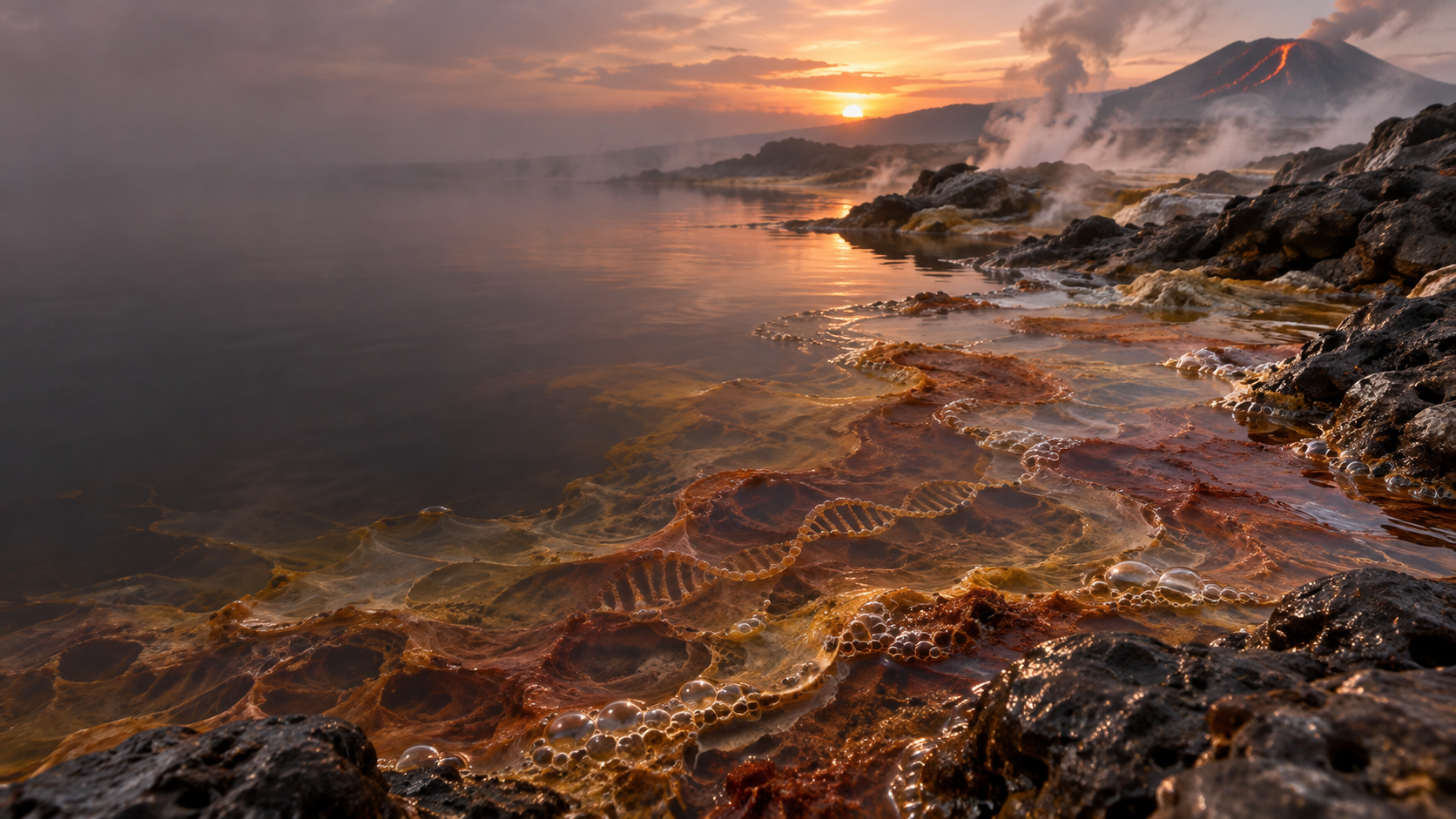
Mountains, deserts, oceans, glaciers, volcanoes, and river channels could still exist. Water would erode rock and transport sediment, wind could reshape exposed terrain, ice could carve valleys, and volcanoes could build new land.
The planet might look barren in some regions but dynamic as a whole. A world without life can still have active weather, changing shorelines, moving sediments, and volcanic landscapes.
Why a Lifeless Planet Could Still Look Living
False Positives in the Search for Life
A false positive occurs when a non-biological process produces a signal compatible with life. The problem is especially important because exoplanet observations are often limited to a few atmospheric measurements.
Volcanism can release gases associated with active chemistry. Photochemical reactions can create oxygen-bearing compounds. Water interacting with rock can produce hydrogen and other chemical products. Stellar radiation can drive atmospheric reactions that do not occur in the same way on Earth.
If a gas or gas combination can form naturally on a lifeless planet, its presence is less decisive than it would be if biology were the only known source.
Earth Is Not the Only Possible Template
Earth provides the only confirmed example of life, so it naturally guides the search for biosignatures. However, scientists continue to investigate whether extraterrestrial organisms could survive in environments unlike those familiar on Earth.
Some research has considered whether microbes might persist with little or no accessible liquid water. Such possibilities challenge narrow definitions of habitability and encourage researchers to investigate alternative environments. Source 9
Scientists therefore need models of both living and non-living planets. They must avoid assuming that alien life will produce exactly the same atmosphere as terrestrial life or require identical conditions.
The Importance of Context
One atmospheric measurement rarely settles the question of life. Stronger evidence would come from observations that fit a plausible climate, stable atmosphere, suitable energy source, chemical disequilibrium, compatible surface or ocean conditions, and a biological explanation stronger than known geological alternatives.
Biosignature interpretation is a process of comparison. Scientists compare observations with models of living planets, barren planets, atmospheric chemistry, geology, and stellar behavior.
How the Simulation Could Improve the Search for Alien Life
Interpreting Exoplanet Atmospheres
A lifeless-Earth baseline can help researchers interpret limited data from distant worlds. Researchers can compare exoplanet observations with models to determine which gases are expected without biology, which combinations are unusual, whether an atmosphere is chemically stable, whether stellar radiation could create the observed compounds, and whether volcanic or geological processes offer a better explanation.
This approach supports more careful use of the terms “biosignature” and “potentially habitable.”
Prioritizing Promising Worlds
Better models can help scientists choose which exoplanets deserve additional observations. Candidate worlds may be assessed by their size, composition, orbit, host star, atmospheric chemistry, temperature, and possible surface or ocean conditions.
A planet with an atmosphere that is difficult to reproduce without biology may become a higher priority. Conversely, a planet with a strong geological explanation for its atmospheric signal may receive less immediate attention.
A promising biosignature is not confirmed life. It is a reason to gather more evidence.
Reducing Earth-Centered Assumptions
Modeling both living and barren planets can reduce Earth-centered assumptions. Scientists must consider life that exists below a surface, uses unfamiliar chemical pathways, survives in extreme environments, or does not produce the atmospheric gases expected from Earth’s dominant organisms.
The search for life requires two forms of caution: researchers must avoid treating every Earth-like feature as proof of biology, and they must avoid rejecting unfamiliar environments simply because they do not resemble modern Earth.
Limits and Uncertainties
A Counterfactual Cannot Be Directly Tested
Scientists cannot observe a second Earth that evolved without life. The model depends on physical laws, geological evidence, atmospheric chemistry, and assumptions about early Earth.
Different starting conditions could produce different results. Changes in volcanic activity, ocean volume, atmospheric composition, solar radiation, or surface chemistry could alter long-term development.
The model should therefore be treated as a scientifically constrained comparison, not a directly verified historical reconstruction.
Models Are Not Photographs of an Alternate Planet
A simulation does not provide a literal picture of what Earth definitely would have become. It produces outcomes based on defined assumptions and equations.
Its strongest contribution is identifying possible planetary states and testing the processes responsible for them. The model can show which features depend on biology, which can emerge without life, and which remain uncertain.
Biosignatures Require Multiple Lines of Evidence
No single gas should be treated as conclusive proof of life. Scientists must compare biological explanations with volcanic, photochemical, geological, and atmospheric alternatives.
Future observations, laboratory experiments, improved climate models, atmospheric studies, and better knowledge of planetary geology will all be necessary. The search for life depends on combining these lines of evidence rather than relying on one spectacular detection.
The Larger Lesson: Life Is a Planetary Force
Life does not merely occupy Earth. It changes Earth.
Organisms have influenced the atmosphere, surface, oceans, climate, sediments, minerals, and carbon cycle. Earth’s current appearance is partly a biological product. A lifeless-Earth simulation makes that influence easier to see by removing it from the model and examining what remains.
The exercise also provides a practical lesson for exoplanet science. To recognize life elsewhere, researchers must understand what a planet can look like without life. Geological activity can produce atmospheres, oceans, climate systems, and chemical signals that resemble biological environments.
A lifeless-Earth baseline will not prove that a distant planet hosts organisms. It can make the test stronger by distinguishing biological signals from non-biological alternatives and improving the search for life beyond the Solar System.
FAQ
What is a lifeless-Earth simulation?
It is a computer model of how Earth’s atmosphere, climate, surface, and chemistry might evolve if life had never appeared. It removes biological activity while retaining processes such as volcanism, weathering, ocean circulation, erosion, and solar radiation.
Why do scientists model Earth without life?
Scientists use the scenario as a baseline for identifying planetary features caused by biology. The comparison can show whether a potential biosignature is difficult to produce through geology or chemistry alone.
Could a lifeless planet have an atmosphere?
Yes. Volcanic activity, chemical reactions, ocean exchange, surface minerals, and stellar radiation can create and alter an atmosphere without life.
Is oxygen definitive proof of life on an exoplanet?
No. Oxygen is an important biosignature candidate, but non-biological processes may produce it under certain conditions. Scientists must study it alongside other gases, stellar radiation, climate, surface conditions, and geological explanations.
What are false positives in the search for extraterrestrial life?
False positives are non-biological signals that resemble evidence of life. Examples include gases produced by volcanism, photochemical reactions, water-rock interactions, or stellar radiation.
Does life elsewhere need liquid water?
Liquid water is central to known Earth biology, but scientists continue to investigate whether organisms could survive in other environments, including places with little or no accessible liquid water. This broadens the search for habitability and biosignatures beyond familiar Earth conditions.