Why U.S. Voters Rejected Data Centers in 2026
Data Centers Were on the Ballot. U.S. Voters Rejected Them
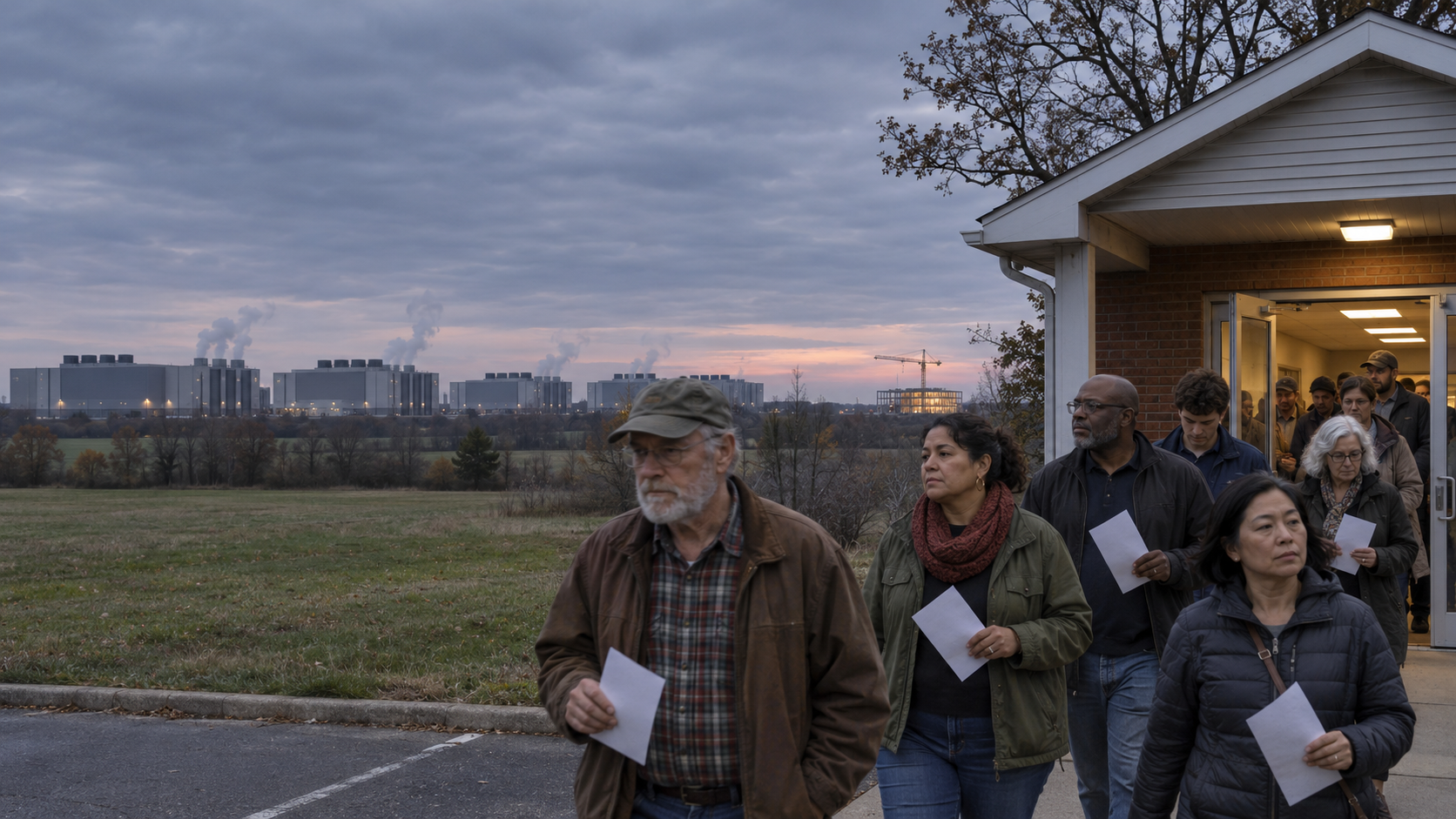
Data centers have moved from planning departments and zoning hearings into electoral politics. In the November 2026 elections, voters in multiple U.S. communities rejected proposed data centers or measures connected to their development, according to reporting from The Guardian, NBC News, and The Washington Post.
The results do not establish a nationwide ban on data-center development. They show something more politically significant: communities are increasingly deciding whether to host the physical infrastructure behind cloud computing, artificial intelligence, streaming, enterprise software, and digital services.
The backlash was captured by a slogan reported in coverage of the issue: “We’re not for sale.” The phrase reflects distrust of development deals that promise investment while leaving residents to evaluate the costs, including electricity demand, water use, industrial construction, tax incentives, noise, and pressure on public infrastructure.
The elections indicate that data-center development is no longer only a technology or business issue. It is now a question of land use, resource allocation, public spending, and local democratic control.
What Voters Rejected in 2026
Data-center development can reach voters through several routes. Residents may vote directly on a proposed facility, a zoning change, a public subsidy, a tax agreement, or restrictions on future projects.
These decisions are not identical. Rejecting one facility does not mean rejecting every data center. Opposing a tax incentive does not necessarily mean opposing the underlying construction. A vote for stricter zoning may permit development under different conditions rather than prohibit it entirely.
The available reporting describes a broad pattern of opposition across multiple communities, not one uniform national vote. The Guardian reported that voters rejected data-center projects or related measures during the November 2026 elections. NBC News described the results as a challenge to the rapid expansion of artificial-intelligence infrastructure. The Washington Post characterized the opposition as a nationwide political backlash that reached polling places.
Local campaigns focused on different concerns. Some emphasized water, while others focused on electricity, tax breaks, farmland, noise, or the relationship between private developers and local governments. Similar election outcomes did not necessarily reflect identical political coalitions.
Why Data Centers Became Controversial
Electricity Demand and Grid Pressure
Data centers can require substantial electricity capacity, particularly facilities designed for intensive AI workloads. Their demand can affect utility planning, transmission construction, generation investments, and emergency-power systems.
Voters want to know how much electricity a facility will consume, whether demand will increase, who will pay for substations and grid upgrades, and whether households or existing businesses could bear related costs.
These questions do not prove that every data center will increase household electricity rates. The effect depends on local utility rules, project contracts, grid conditions, and cost-allocation policies. The underlying political issue is responsibility: should developers, utilities, taxpayers, or ordinary customers finance infrastructure built partly to serve private computing facilities?
A facility may resemble an industrial power user even when its final product is digital. That concern becomes more urgent as AI systems require larger clusters of specialized processors and continuous cooling.
Water Use and Resource Competition
Water consumption has become another major source of opposition, especially in areas facing drought or limited supplies. Cooling systems may use water directly, indirectly, or through a combination of technologies. The impact depends on the facility’s design, climate, operating schedule, and water source.
Residents commonly seek clear information about annual consumption, peak usage during hot weather, reliance on drinking-water supplies, conservation requirements, and public reporting after construction. They also want to know whether agriculture, households, or other businesses could face additional pressure.
Water is politically visible because communities understand competition for a limited resource. Promises of jobs may not persuade residents who believe a project could strain reservoirs, aquifers, or municipal systems.
Land, Noise, and Quality of Life
Data centers are often large industrial buildings. Their local footprint may include construction traffic, substations, backup generators, security lighting, cooling equipment, and new roads.
Residents may oppose the conversion of open space or farmland, heavy vehicles, construction dust, continuous equipment noise, generator testing, nighttime lighting, diesel emissions, and potential declines in property or environmental quality.
The digital services supported by a facility may benefit users nationwide or globally. The physical effects, however, are concentrated in one community. Residents experience the land, traffic, noise, and infrastructure burden, while broader economic benefits may be dispersed.
Tax Incentives and Public Costs
Subsidies and tax breaks can turn a planning dispute into a campaign about fairness. Data centers may attract substantial capital investment, but the public must evaluate how much revenue remains after exemptions, abatements, infrastructure spending, and service costs.
Voters may ask how much tax revenue the project will generate, how many permanent jobs will remain after construction, how long incentives will last, whether projected benefits are guaranteed, and whether schools, emergency services, roads, or utilities will require additional funding.
The “We’re not for sale” message reflects concern that local governments may offer valuable incentives without securing proportional benefits. It also signals that residents want to see the full contract, not only headline investment figures.
Economic Growth Versus Local Control
Supporters present data centers as major infrastructure and economic-development opportunities. Their arguments include construction employment, new tax revenue, industrial investment, regional technology growth, expanded digital infrastructure, demand for contractors and suppliers, and support for AI and cloud-computing services.
Supporters may warn that lengthy approval processes will send investment to other regions. For some local governments, data centers offer a way to reuse industrial land, expand the tax base, and attract related technology businesses. The strongest case depends on verifiable commitments rather than general claims about innovation.
Opponents argue that local costs can exceed direct benefits. Permanent employment may be limited after construction ends, while electricity, water, road, and emergency-service demands continue.
Their concerns include infrastructure costs transferred to residents, uncertain tax benefits, difficult-to-reverse environmental impacts, limited public leverage after approval, industrial development near homes, insufficient disclosure of resource use, and incentive agreements negotiated without broad participation.
Opposition does not always mean hostility to technology or artificial intelligence. A campaign may support data centers in principle while rejecting a particular site, subsidy package, environmental plan, or approval process.
Local control connects concerns that otherwise belong to separate policy categories. Residents who disagree about AI may still agree that communities should have access to project information and authority over land-use decisions.
Common demands include:
- Public hearings
- Transparent contracts
- Independent impact studies
- Binding energy and water commitments
- Enforceable community benefits
- Stronger zoning rules
- Noise and emissions limits
- Authority to reject or modify projects
What the Results Mean for AI Infrastructure
AI growth requires more than chips, software, and investment. It also requires land, power, cooling systems, fiber networks, transmission capacity, permits, and community acceptance.
Voter rejection adds a political constraint to infrastructure planning. A project can be financially viable and technically feasible yet fail because it lacks public legitimacy. That constraint may become more important as facilities grow larger and their resource requirements become more visible.
Developers may need to disclose expected electricity demand, water use under normal and extreme conditions, grid-upgrade responsibilities, temporary and permanent job estimates, tax incentives, construction schedules, noise and lighting controls, backup-power systems, emissions plans, and binding mitigation requirements.
Community engagement is more credible when commitments are enforceable. Voluntary promises may not persuade residents who expect a project to operate for decades.
The industry may respond by choosing locations with surplus electricity, reliable transmission, available industrial land, and clearer permitting rules. Other strategies include using reclaimed or nonpotable water, redeveloping industrial sites, locating farther from residential areas, and negotiating community-benefit agreements.
Relocation would not eliminate national concerns. Electricity demand, water use, emissions, and infrastructure costs would still require public scrutiny in the new location.
The “We’re Not for Sale” Message
“We’re not for sale” turns a technical development debate into a question of civic power. It suggests that developers receive incentives while communities absorb environmental and infrastructure costs.
The slogan also challenges the assumption that any investment is automatically beneficial. Residents want to know who receives the gains, who carries the risks, and whether public officials negotiated a fair agreement.
Economic arguments lose force when voters distrust the numbers. That distrust can grow when job estimates combine temporary construction work with permanent positions, tax benefits depend on exemptions, infrastructure costs are not fully disclosed, environmental impacts are difficult to quantify, contracts limit public oversight, or community benefits lack enforcement mechanisms.
Residents may reject a project not because they oppose development, but because they believe the decision was negotiated before the public could meaningfully participate.
What Happens After a Rejection?
A rejected project may lead to reconsideration, litigation, a revised site plan, a smaller facility, a new incentive proposal, or relocation. The available reporting does not establish that every rejected project is permanently canceled.
Developers may return with stronger water protections, different cooling systems, reduced noise, revised traffic plans, or more substantial community benefits. They may also seek locations with fewer residential impacts or clearer permitting rules.
Communities must decide what comes next. Local officials may need to determine whether existing zoning rules address data-center-specific risks and whether new standards are necessary.
Follow-up questions include:
- Will the vote affect similar future projects?
- Are current zoning standards sufficient?
- Should governments create data-center-specific rules?
- How will officials protect water and grid capacity?
- What information must applicants disclose?
- Should community benefits be mandatory?
- How will officials monitor compliance after approval?
A rejection may stop one proposal while leaving the underlying policy framework unchanged. Without new standards, the same conflict may return with another developer or another site.
Conclusion: AI Infrastructure Must Earn Public Consent
Data centers became ballot issues in the 2026 U.S. elections, and voters rejected projects or measures tied to their expansion in multiple communities. The results do not prove that Americans oppose every data center or the broader development of artificial intelligence.
They show that voters are demanding better terms, stronger safeguards, and a clearer share of the benefits.
AI infrastructure is now a public-policy issue. It affects land, electricity, water, taxation, roads, noise, and local authority. Companies can no longer treat community approval as a procedural step after major business decisions are complete.
The test for future data-center projects will be whether developers and governments can demonstrate that communities gain more than they give up. That requires transparent contracts, credible impact studies, enforceable commitments, and meaningful local participation.
The question is no longer whether data centers are important. It is whether their expansion can earn public consent.
FAQ
Why were data centers on the ballot in the 2026 U.S. elections?
Data centers appeared in local political campaigns because their development can affect zoning, electricity demand, water use, taxes, land use, and public infrastructure. Voters considered projects and measures connected to this expansion.
Did U.S. voters reject all data centers?
No. Reporting describes voters rejecting proposed data centers or related measures in multiple communities. It does not establish a nationwide ban or show that every data-center proposal failed.
Why are data centers controversial?
Opponents commonly cite electricity consumption, grid upgrades, water use, noise, land use, tax incentives, and limited permanent employment. Supporters emphasize construction activity, investment, tax revenue, and the infrastructure’s role in AI and cloud services.
What does “We’re not for sale” mean in the data-center debate?
The slogan expresses opposition to development deals that residents view as overly favorable to companies. It reflects demands for transparent agreements, enforceable community benefits, and protection from costs that may fall on taxpayers, utility customers, or residents.
Will the election results slow AI development?
They may slow or complicate some projects by increasing permitting and political risks. The overall effect will depend on whether developers relocate, revise proposals, negotiate stronger benefits, or secure new state and local policies.
What should communities examine before approving a data center?
Communities should review projected electricity and water use, grid-upgrade costs, tax incentives, permanent jobs, construction impacts, noise, emissions, emergency planning, and enforceable mitigation requirements. Officials should require clear public reporting before approving projects.